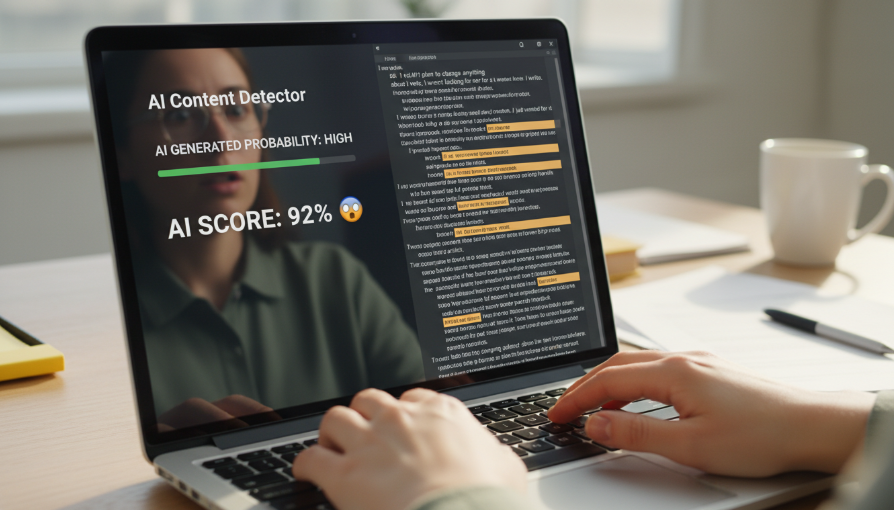
Many users are surprised when their content gets flagged as AI-generated—even when they’ve edited it or written parts of it themselves.
The issue isn’t always about whether AI was used. More often, it’s about how the content looks from a pattern perspective.
Understanding why content gets flagged is the first step toward fixing it.
What Triggers AI Detection in the First Place
Predictable Sentence Structures
AI-generated content tends to follow highly consistent sentence patterns.
You’ll often see similar sentence lengths, repeated structures, and smooth but uniform transitions. While this makes the text easy to read, it also makes it easier to detect.
Even human-written content can trigger this if it becomes too structured.
Overly Balanced Tone
AI writing usually avoids extremes. It stays neutral, clear, and evenly paced.
But real human writing often includes variation—some sentences are sharper, some are more casual, and others may even feel slightly imperfect.
A perfectly balanced tone can actually become a signal of AI involvement.
Repetition Without Realizing It
AI tends to reuse phrases and sentence patterns subtly.
You might not notice it at first, but detection tools can identify these repetitions across the entire text.
This is one of the most common reasons content gets flagged.
Why Editing Alone Doesn’t Always Work
Surface Changes vs. Deep Structure
Many users try to fix detection issues by replacing words or rephrasing sentences.
While this can help slightly, it usually doesn’t change the deeper structure of the content. The overall rhythm and predictability often remain the same.
That’s why edited content can still be flagged by an AI Detector.
Partial Human Input Isn’t Enough
Adding a few human-written sentences into an AI-generated draft doesn’t always solve the problem.
If the majority of the content still follows AI patterns, detection tools will continue to pick up on those signals.
Consistency matters more than isolated edits.
How to Actually Fix Flagged Content
Break the Pattern
The most effective way to reduce detection signals is to introduce variation.
Change sentence lengths. Mix short and long sentences. Use different structures instead of repeating the same format.
This disrupts the uniformity that detectors look for.
Add Real Context and Specificity
AI content often stays generic.
Adding specific examples, personal insights, or unique perspectives makes the content more distinctive. This not only improves quality but also reduces AI-like patterns.
Adjust the Flow, Not Just the Words
Instead of focusing only on wording, rethink how ideas are presented.
Reordering sections, adding interruptions, or introducing less predictable transitions can make a big difference.
This changes the overall structure, which is what detection tools analyze most.
A Practical Fix Workflow
Step 1: Run Detection
Start by analyzing your content with an AI Detector to identify which sections are most likely to be flagged.
Focus on patterns, not just the overall score.
Step 2: Identify Weak Sections
Look for areas that feel too smooth, too consistent, or repetitive.
These sections usually contribute the most to detection signals.
Step 3: Rewrite With Variation
Instead of lightly editing, rewrite key sections with more variation.
Introduce different sentence styles, adjust tone, and add more natural flow.
Step 4: Refine With Additional Tools
Some users use tools like the AI Humanizer to further improve readability and reduce uniformity.
This step helps smooth out the final result without reintroducing AI patterns.
Step 5: Recheck Before Publishing
After making changes, run detection again.
This iterative process helps ensure that improvements are actually effective.
Common Mistakes to Avoid
Over-Editing
Trying too hard to “fix” content can make it sound unnatural.
The goal is not to trick detection systems, but to create better, more natural writing.
Ignoring Content Quality
Passing detection does not guarantee quality.
Content should still be useful, clear, and engaging. Detection is only one part of the equation.
Relying Only on Tools
Tools can guide the process, but they cannot replace human judgment.
Final decisions should always involve a human review.
Final Thoughts
Getting flagged as AI is not necessarily a problem—it’s a signal.
It shows that your content may be too uniform, too predictable, or lacking variation.
By understanding these patterns and addressing them directly, you can improve both detection results and overall content quality.
Dechecker provides an AI Detector that helps identify these issues clearly. By combining detection with thoughtful editing and refinement, users can create content that is not only harder to flag, but also more engaging and effective.